By Dr. Mikiko Murakami, DO | Board-Certified in Pain Medicine and PM&R | Walnut Creek, California
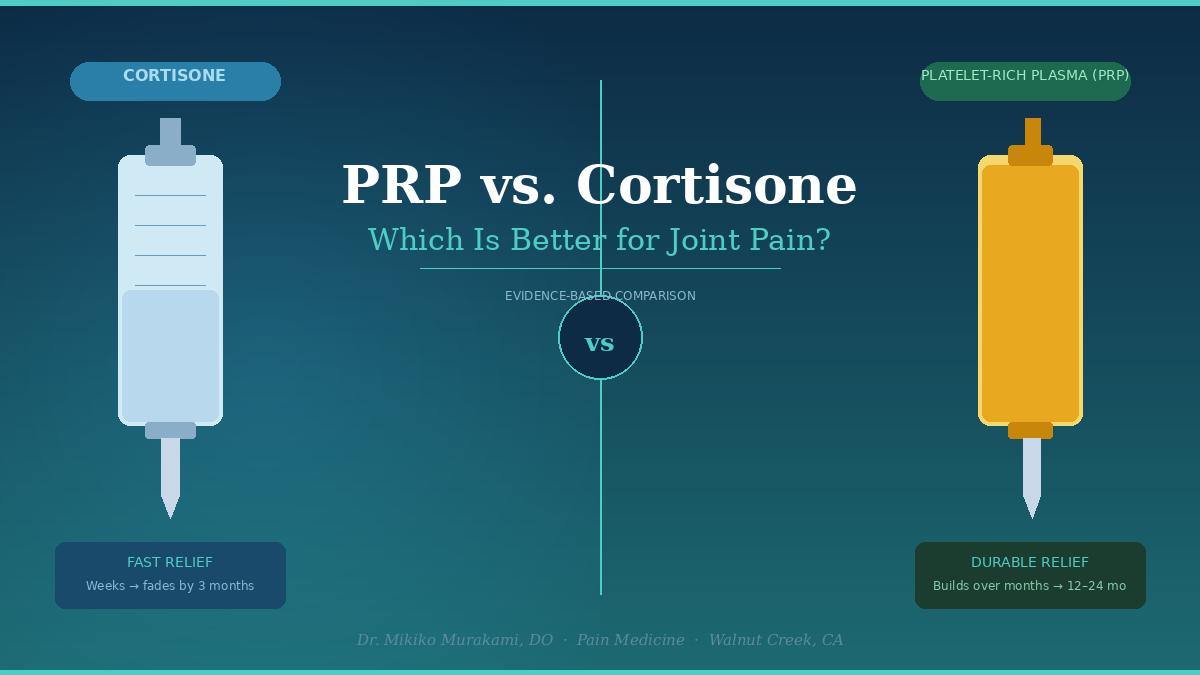
If you have been living with knee pain, shoulder pain, or another joint condition, there is a good chance your doctor has offered you a cortisone shot. For decades, corticosteroid injections have been the standard go-to for joint pain relief — fast, covered by insurance, and familiar to almost every physician. But platelet-rich plasma (PRP) injections are now one of the most common questions in my Walnut Creek pain medicine practice, and patients want an honest answer: is PRP actually better than a cortisone shot, or is it just an expensive trend?
The honest answer is: it depends. This article walks through what the current evidence actually says, where each treatment works best, and how I help patients in the East Bay make this decision for their specific situation.
What Is a Cortisone Shot, and How Does It Work?
Corticosteroids — often called “cortisone” or “steroid” shots interchangeably — are powerful anti-inflammatory medications. When injected directly into a joint, tendon sheath, or bursa, they reduce inflammation quickly, often within days. For patients who need to get through a flare, a painful event, or a period where they simply cannot function, cortisone can be genuinely useful.
The limitation is that cortisone treats the symptom — inflammation — but does not address the underlying structural problem. It does not repair cartilage, heal tendons, or slow the progression of arthritis. And when used repeatedly, the evidence is compelling that it may cause harm to the very tissues it is meant to help.
What Is PRP, and How Does It Work?
Platelet-rich plasma (PRP) is made from your own blood. A small sample is drawn and processed in a centrifuge to concentrate the platelets and the growth factors they carry — including platelet-derived growth factor, vascular endothelial growth factor, and transforming growth factor-β. That concentrated solution is then injected precisely into the affected area — a joint, tendon, disc, or ligament — often using ultrasound or fluoroscopic guidance.
Unlike cortisone, PRP works with your body’s own healing mechanisms. The goal is not just to suppress inflammation in the short term but to modulate the biological environment of the injured tissue — reducing destructive inflammatory signals while supporting repair and regeneration over time.
PRP is not a cure, and I want to be clear about that. It cannot fully regenerate a joint that has been severely damaged, grow new cartilage from nothing, or reverse advanced arthritis. What it can do, for the right patient, is reduce pain and inflammation, improve function, and potentially slow further deterioration.
What Does the Research Say? PRP vs. Cortisone Shot
Knee Osteoarthritis
Knee osteoarthritis is the most studied indication for PRP, and the evidence is genuinely encouraging. Multiple network meta-analyses of randomized controlled trials have found that PRP demonstrates the highest probability of efficacy for both pain and function at 6- and 12-month follow-up, outperforming corticosteroids, hyaluronic acid, and placebo. A 2024 network meta-analysis in Arthroscopy, analyzing 48 studies and over 9,300 knees, found that PRP had the highest overall ranking for improvement in both pain and function, while corticosteroids ranked near the bottom — just above placebo.
A 2025 systematic review published in Cureus evaluated six RCTs from 2019 to 2024 comparing intra-articular PRP to corticosteroid injections for knee OA. Both treatments reduced pain and improved symptoms, but PRP showed more durable benefit at longer follow-up intervals.
Meanwhile, a landmark two-year randomized trial found that corticosteroid injections given every 12 weeks resulted in significantly greater cartilage volume loss on MRI compared to saline, without a corresponding improvement in pain — raising concern about the value of frequent repeat cortisone injections for the knee.
I want to be balanced here: not all studies favor PRP. A well-designed large RCT found no meaningful improvement with PRP compared to saline placebo. The picture is not uniformly positive, and your overall health also plays a role in the success of PRP.
Tennis Elbow (Lateral Epicondylitis)
This is one of the clearest cases in the literature where PRP demonstrates a meaningful long-term advantage. A 2024 meta-analysis in The American Journal of Sports Medicine, analyzing 11 RCTs with 730 patients, found that cortisone produced better short-term pain relief (under two months), but PRP produced significantly superior outcomes at six months and beyond — with large effect sizes for both pain and function.
For a condition that is degenerative rather than primarily inflammatory, this pattern makes biological sense: cortisone calms the fire quickly but does not help the tendon heal, while PRP supports the underlying tissue repair process. It is also worth noting that glucocorticoid injections for lateral epicondylitis have been shown to produce worse long-term outcomes than even a wait-and-see approach, suggesting that the short-term relief may come at a cost.
Rotator Cuff Tendinopathy and Shoulder Pain
Multiple RCTs demonstrate that PRP produces superior pain and functional outcomes compared to corticosteroid injections at 6 and 12 months for rotator cuff tendinopathy. A 2024 double-blinded RCT of 100 patients published in the Journal of Shoulder and Elbow Surgery found that PRP produced significantly greater improvements in pain, function, and sleep quality at 12 months, with a treatment failure rate of only 12% compared to 30% in the corticosteroid group.
A 2026 systematic review and meta-analysis of 10 RCTs confirmed that PRP provided statistically significant improvements in shoulder function scores and pain reduction at 6 months, with fewer adverse events than corticosteroids. For patients weighing options before potential surgery, this time profile is worth understanding: PRP takes longer to work, but the results tend to be more durable.
Facet Joint and Low Back Pain
The evidence for PRP in spinal pain is earlier-stage but growing. A 2026 systematic review and meta-analysis of 10 randomized and quasi-randomized trials comparing PRP to corticosteroids for facet and sacroiliac joint pain found that PRP significantly reduced pain at 3 months and 6 months compared to corticosteroids, though the certainty of evidence remains limited.
However, not all studies agree. A 2026 controlled, randomized, double-blind study of 76 patients with facet joint syndrome found no superiority of PRP over corticosteroids for pain relief at 6 or 12 months. For patients with degenerative facet osteoarthritis who are looking for an option that goes beyond temporary suppression, PRP is a reasonable consideration — but the evidence is less mature than for knee OA or tennis elbow.
The Long-Term Safety Question: What Cortisone Does to Tissue Over Time
This is the part of the conversation that does not happen often enough in a standard office visit. Cortisone shots can be effective for an acute inflammatory condition, but repeated use carries real risks that are now well-documented in the literature and addressed in the 2025 ASRA/AAPM/ASIPP/ISIS guidelines on corticosteroid injection safety:
- Cartilage damage: Corticosteroids have dose-dependent detrimental effects on cartilage, including catabolic effects on aggrecan, type II collagen, and proteoglycans, as well as reduced chondrocyte viability. A two-year randomized trial found that corticosteroid injections every 12 weeks resulted in significantly greater cartilage volume loss on MRI compared to saline.
- Tendon weakening: A systematic review of 50 studies found that local glucocorticoid administration significantly reduces tendon cell viability, collagen synthesis, and mechanical properties, with increased collagen disorganization and necrosis — potentially increasing the risk of tendon rupture, particularly in weight-bearing tendons and the rotator cuff.
- Rapidly progressive osteoarthritis: Cases of rapidly progressive osteoarthritis and femoral head collapse have been reported following intra-articular corticosteroid injections, even in patients without pre-existing severe joint damage.
- Surgical infection risk: Meta-analyses have found that corticosteroid injections within 3 months prior to joint arthroplasty significantly elevate the risk of periprosthetic joint infection. The AAOS clinical practice guidelines and multiple meta-analyses recommend against performing total joint arthroplasty within 3 months of a corticosteroid injection. For patients who may eventually need joint replacement, timing of cortisone injections matters.
I want to be fair to cortisone here as well. Large observational studies, including combined data from the MOST and OAI cohorts, found that patients receiving steroid injections did not have a greater risk of OA progression or knee replacement compared to those who received hyaluronic acid. A population-based cohort study also found no significant change in cartilage thickness when corticosteroid injections were used only for symptomatic flare-ups rather than on a fixed schedule. The evidence is mixed, and the risks of cortisone are not uniform across all patients and all joints.
What the research does support is that repeated cortisone injections carry accumulating risks that are worth weighing carefully — particularly in younger patients or those hoping to delay or avoid joint replacement.
PRP vs. Cortisone: How I Think About This With My Patients in Walnut Creek
There is no universal answer to which treatment is better — it depends on whether you are having an acute or chronic condition, as well as your overall health and goals.
Cortisone makes more sense when: you need rapid relief to function (an important event, a surgical optimization window, a temporary severe flare), when the diagnosis is primarily inflammatory rather than degenerative, or when cost and insurance coverage are the overriding constraint.
PRP makes more sense when: the underlying problem is degenerative (tendinopathy, mild to moderate osteoarthritis, disc degeneration), when you have already had multiple cortisone shots with diminishing returns, when you are trying to delay or avoid surgery, or when you are concerned about the long-term tissue effects of repeated corticosteroid use.
PRP is not appropriate for everyone, and I do not offer it as a default. The right candidate has the right diagnosis, realistic expectations, and a clear understanding of what the evidence does and does not support. I also want to be direct about what PRP costs: it is not covered by insurance, and you may require more than one injection. That conversation is part of any honest evaluation.
How to Get a PRP Evaluation in Walnut Creek
If you are in the East Bay — Walnut Creek, Lafayette, Orinda, Danville, Pleasanton, or the broader Lamorinda area — and you are wondering whether PRP might be right for your joint pain, I am happy to talk through your specific situation. My practice is cash-pay and regenerative medicine-focused, which means appointments are not rushed and the evaluation is thorough.
No referral is required. You can request a consultation by calling my office at 877-933-7133 or using the contact form on this website.
References
- Jawanda H, Khan ZA, Warrier AA, et al. Platelet-Rich Plasma, Bone Marrow Aspirate Concentrate, and Hyaluronic Acid Injections Outperform Corticosteroids in Pain and Function Scores at a Minimum of 6 Months as Intra-Articular Injections for Knee Osteoarthritis: A Systematic Review and Network Meta-Analysis. Arthroscopy. 2024;40(5).
- Diaz Haaz DI, Rizo Castro O. Efficacy and Safety of Intra-articular Platelet-Rich Plasma (PRP) Versus Corticosteroid Injections in the Treatment of Knee Osteoarthritis: A Systematic Review of Randomized Clinical Trials. Cureus. 2025;17(3):e80948.
- Xu Y, Li T, Wang L, et al. Platelet-Rich Plasma Has Better Results for Long-Term Functional Improvement and Pain Relief for Lateral Epicondylitis: A Systematic Review and Meta-Analysis of Randomized Controlled Trials. Am J Sports Med. 2024;52(8).
- Wolf JM. Lateral Epicondylitis. N Engl J Med. 2023;388(25).
- Rossi LA, Brandariz R, Gorodischer T, et al. Subacromial Injection of Platelet-Rich Plasma Provides Greater Improvement in Pain and Functional Outcomes Compared to Corticosteroids at 1-Year Follow-Up: A Double-Blinded Randomized Controlled Trial. J Shoulder Elbow Surg. 2024;33(12).
- Yuwarungsikul C, Phisalaphong K, Thamrongskulsiri N, et al. Platelet-Rich Plasma Provides Modest but Durable Functional Benefit Over Corticosteroid for Rotator Cuff Tendinopathy: A Systematic Review and Meta-Analysis of Randomized Controlled Trials. Knee Surg Sports Traumatol Arthrosc. 2026.
- Alatefi D, Alkabazi M, Alanzi A, et al. Platelet-Rich Plasma Versus Corticosteroid Injections for Facet and Sacroiliac Joint Pain: A Systematic Review and Meta-Analysis With Trial Sequential Analysis. Pain Med. 2026.
- Geoffroy M, Beissat M, Kanagaratnam L, et al. Platelet-Rich Plasma Versus Corticosteroids in Facet Joint Syndrome: A Controlled, Randomized, Double-Blind Study. Joint Bone Spine. 2026;93(3).
- Benzon HT, Provenzano DA, Nagpal A, et al. Use and Safety of Corticosteroid Injections in Joints and Musculoskeletal Soft Tissue: Guidelines From ASRA, AAPM, ASIPP, and ISIS. Reg Anesth Pain Med. 2025.
- Dean BJ, Lostis E, Oakley T, et al. The Risks and Benefits of Glucocorticoid Treatment for Tendinopathy: A Systematic Review of the Effects of Local Glucocorticoid on Tendon. Semin Arthritis Rheum. 2014;43(4).
- Lai Q, Cai K, Lin T, et al. Prior Intra-Articular Corticosteroid Injection Within 3 Months May Increase the Risk of Deep Infection in Subsequent Joint Arthroplasty: A Meta-Analysis. Clin Orthop Relat Res. 2022;480(5).
- Donovan RL, et al. Evidence suggests that intraarticular corticosteroids are effective (short term) and safe (long term). Osteoarthritis Cartilage. 2022;30(10).
- Risks of Intra-articular Hip Corticosteroid Injections Include Rapidly Progressive Osteoarthritis and Femoral Head Collapse. ScienceDirect. 2025.
Last reviewed: July 2026 | Dr. Mikiko Murakami, DO — Dual Board-Certified in Physical Medicine & Rehabilitation and Pain Medicine. Practicing at Evolved Medical, 1270 Springbrook Road Suite E, Walnut Creek, CA 94597.

Dr. Mikiko Murakami is a dual board-certified physician in Physical Medicine & Rehabilitation (PM&R) and Pain Medicine, practicing in Walnut Creek, California. She is the founder of Bay Area Pain Rehab, PC and sees patients for regenerative medicine and orthobiologics at Evolved Medical, 1270 Springbrook Road Suite E, Walnut Creek, CA 94597.
Dr. Murakami completed her Pain Medicine fellowship at UC San Diego and her PM&R residency at Mount Sinai Medical Center. She is a Qualified Medical Examiner (QME) for the California Division of Workers' Compensation, and also serves as an Expert Witness on federal cases. She also serves as adjunct clinical faculty for Touro University College of Osteopathic Medicine, and has published in peer-reviewed pain medicine literature.
Her clinical focus is combining various therapies, which includes regenerative medicine — including platelet-rich plasma (PRP), bone marrow aspirate concentrate (BMAC), and alpha-2-macroglobulin (A2M) injections — for patients with joint pain, osteoarthritis, tendinopathy, and spine conditions who are seeking alternatives to surgery or long-term medication. She writes on spine and joint longevity, musculoskeletal health, and regenerative medicine for an informed general audience.