What Is PRP?
Platelet-rich plasma (PRP) is a regenerative treatment derived from your own blood. A small blood sample is drawn, then processed in a centrifuge to concentrate the platelets — the components of blood richest in growth factors and signaling proteins that drive tissue repair and inflammation modulation.
The resulting concentrated plasma is injected directly into the injured area, typically under ultrasound or fluoroscopic guidance for accuracy. Because PRP is made entirely from your own blood, allergic reactions are extremely rare and there is no risk of rejection.
PRP injections are offered at Dr. Murakami’s Walnut Creek practice for patients throughout the East Bay, Lamorinda, and Contra Costa County.
How PRP Works
Platelets do more than help blood clot — they release a cascade of growth factors, anti-inflammatory messengers, and signaling proteins that help the body repair damaged tissue.
When concentrated and injected into an area of injury or degeneration, PRP may help:
- Reduce chronic inflammation
- Support tissue healing in tendons, ligaments, and cartilage
- Attract the body’s own repair cells to the injury site
- Slow the progression of degenerative changes
PRP does not create new tissue or reverse severe structural damage. It creates a pro-healing environment that supports the body’s own repair mechanisms — often leading to meaningful improvements in pain and function for appropriately selected patients.
Conditions Treated with PRP
PRP injections are most well-supported by evidence for tendon injuries and mild to moderate joint degeneration. Conditions commonly treated include:
- Knee osteoarthritis
- Rotator cuff tendinopathy and shoulder arthritis
- Tennis elbow and golfer’s elbow
- Hip osteoarthritis
- Achilles tendon injuries
- Neck and low back arthritis
- Degenerative disc disease
Before Your PRP Procedure
To protect the effectiveness of your treatment, avoid NSAIDs (such as ibuprofen, Mobic, or Celebrex) for at least one week before and one week after your PRP injection. NSAIDs directly counteract the inflammatory signaling that makes PRP effective.
What to Expect During the Procedure
The procedure is performed in-office or at an accredited ambulatory surgery center (ASC) depending on the injection site and complexity.
For clinic PRP procedures, it typically takes under an hour from start to finish. For ASC PRP procedures, it may take longer. What to expect:
- A small blood sample is drawn from your arm
- The sample is processed in a centrifuge to concentrate the platelets
- The PRP is injected into the target area under ultrasound or fluoroscopic guidance
Recovery and Results
Most patients return to light activity the same day, with mild soreness at the injection site being the most common side effect. The downtime is minimal.
Improvements develop gradually — most patients notice meaningful changes in pain and function within two to six weeks. Some respond well after a single injection; others benefit from a short series depending on the condition and its severity.
PRP vs. Corticosteroid Injections
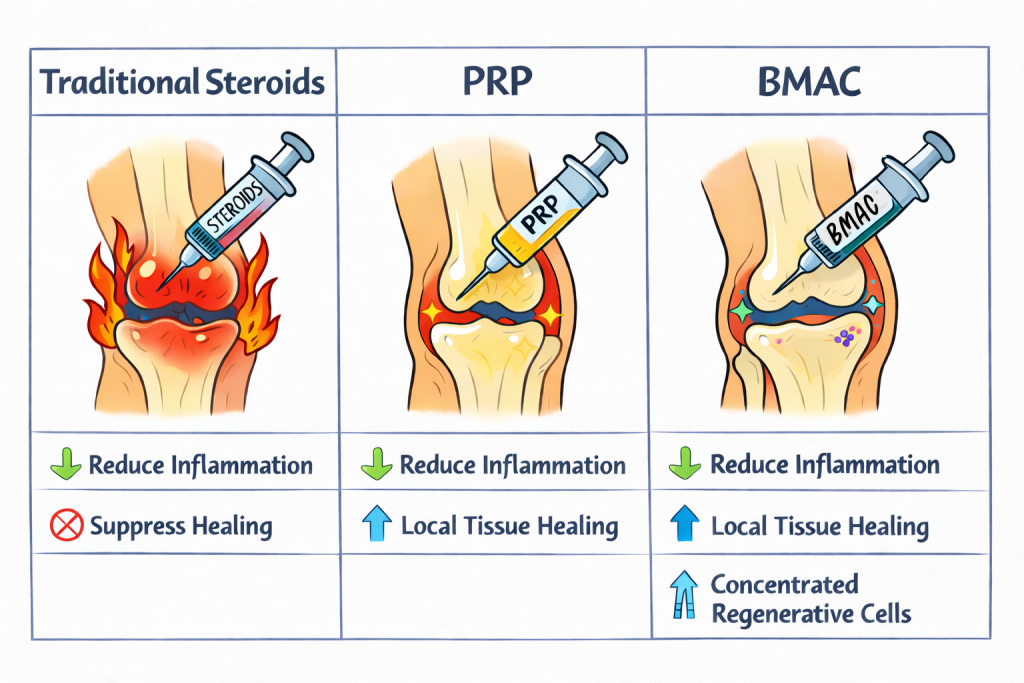
Corticosteroid injections can provide rapid pain relief by suppressing inflammation, but repeated use may weaken tendons and cartilage over time. PRP works differently — rather than suppressing the body’s response, it leverages the body’s own healing mechanisms to address the underlying problem.
For patients seeking a more durable solution, or those who have had diminishing returns from steroid injections, PRP is often worth considering. The two approaches are not mutually exclusive, and the right choice depends on the clinical picture, patient goals, and timing.
Is PRP Right for You?
PRP is not appropriate for every patient or every condition. Candidacy depends on your diagnosis, imaging findings, prior treatment history, and overall health. It is generally most effective for mild to moderate joint degeneration and tendon injuries — and less likely to be beneficial for severe, bone-on-bone arthritis or large structural tears where surgery is clearly indicated.
The decision to proceed with PRP is made during your consultation after a thorough evaluation.
This page was last reviewed March 2026.